
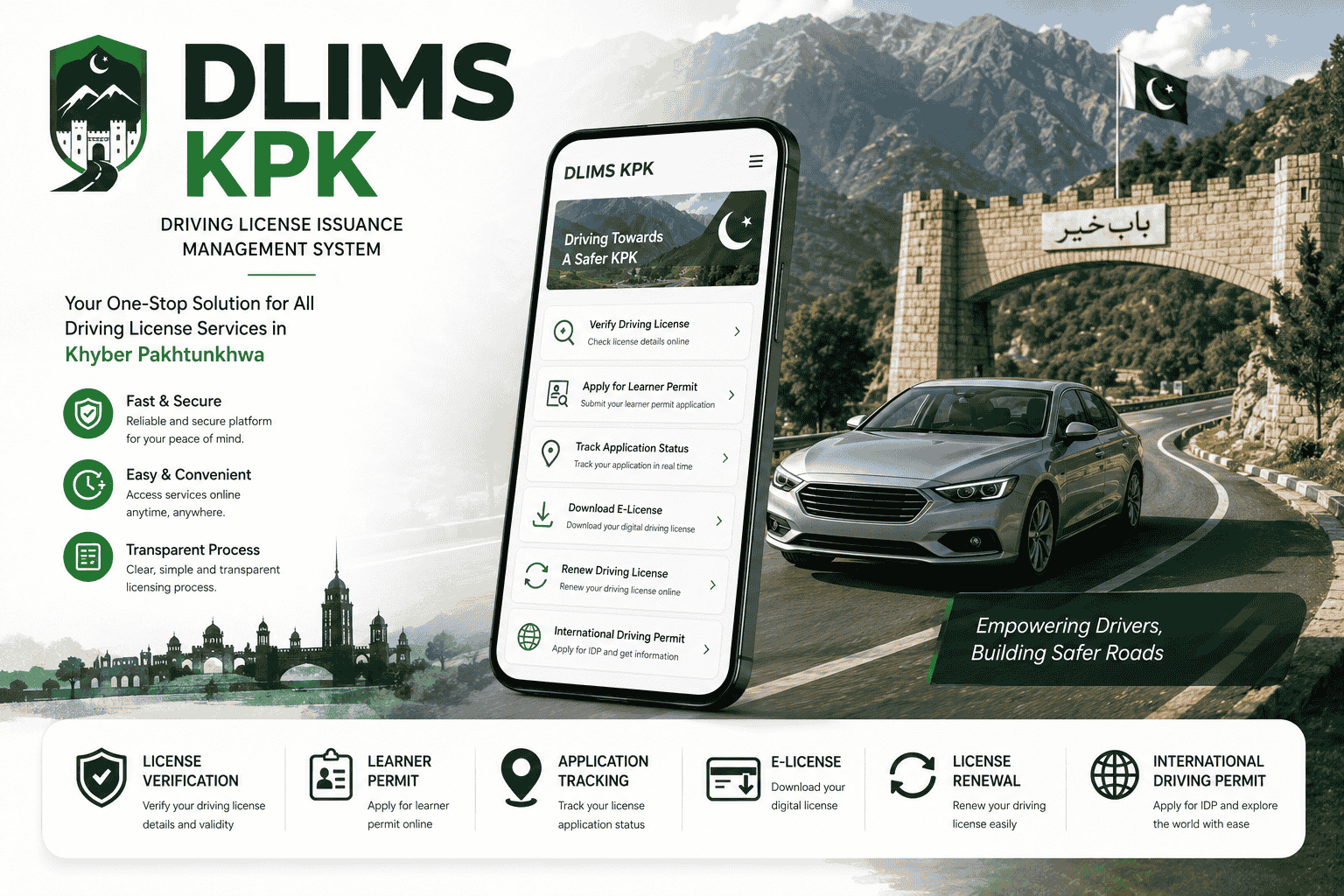
DLIMS KPK Driving License Check and Online Verification:-
A driving license is more than a card in your wallet , across Khyber Pakhtunkhwa, it is your legal authority to be on the road. So before you hand it to an employer, present it at a checkpoint, or carry it abroad, it pays to know it is genuine and still in date. That is precisely what DLIMS KPK lets you do: punch in your CNIC, hit verify, and read your license record straight from the provincial database in moments.
Run by the Khyber Pakhtunkhwa Traffic Police, the system covers learners, private drivers, and commercial operators alike , from Peshawar and Mardan to Swat, Kohat, Bannu, and Dera Ismail Khan. Notably, KPK has moved its entire issuance chain onto digital rails, with fingerprint capture, automated test results, and tamper-resistant RFID license cards issued under a stated zero-tolerance-to-corruption policy.
Check Your KPK Driving License Online:
Confirming a Khyber Pakhtunkhwa license takes well under a minute and costs nothing. All you need is your identity card number. Here is the route:
- Go to the KP Traffic Police verification page at ptpkp.gov.pk.
- Type your CNIC as 13 continuous digits — skip the dashes (example: 17501234567XX).
- Press Verify to send your request to the database.
- Read your record as the system returns your license status on screen.
Featured-snippet answer: Open ptpkp.gov.pk, enter your 13-digit CNIC without dashes, and click Verify. Your Khyber Pakhtunkhwa driving license status and details load within seconds, free of charge.
Because the KP Traffic Police extended online checking to every license category, the same lookup works whether you hold a motorcycle endorsement or a heavy-vehicle license.
Reading Your Verification Result:
A successful lookup returns the official particulars tied to your CNIC. Expect fields such as these:
Detail Shown | Why It Matters |
Holder’s name | Confirms the rightful owner |
License class | Tells you which vehicles you may legally drive |
Date of issue | Marks when authorisation began |
Date of expiry | Flags when renewal falls due |
Current status | Active, expired, or still processing |
Treat the expiry date as your action line. Driving past it counts as driving unlicensed under KPK law, which invites fines and possible vehicle action — so renew before that date arrives, not after.
License Category Issued Across Khyber Pakhtunkhwa:-
The KP Traffic Police groups licenses by the kind of vehicle each one permits. Matching your real-world driving to the correct class keeps you legal and helps you read your verification result accurately.
| Class | Permitted Vehicles |
|---|---|
| Motorcar / Jeep | Private, non-commercial cars only |
| Light Transport Vehicle (LTV) | Commercial taxis, jeeps, mini buses, and light goods transport |
| Heavy Transport Vehicle (HTV) | Buses, trucks, trailers, and other heavy vehicles |
| Public Service Vehicle (PSV) | Passenger-carrying vehicles for hire |
| Learner Permit | A temporary authorisation to practise before testing |
| International Driving License | Driving in countries that recognise the permit |
A point worth remembering: a Motorcar/Jeep license does not cover commercial work. If you drive a taxi or mini bus for income, you need an LTV class, not a private-car endorsement.
Who Can Apply and at What Age:
Eligibility in KPK hinges on age and vehicle type. The thresholds set by the provincial authority are straightforward:
- 18 years — the minimum for a motorcycle or private car learner permit.
- 21 years — required for commercial categories such as rickshaw, taxi, tractor, and other LTV driving.
- Higher age plus experience — expected for heavy-vehicle (HTV) work, which carries the toughest testing.
A welcome detail for the province: KPK’s learner application process explicitly accommodates both Pakistani and Afghan nationals, reflecting the region’s resident population.
Documents You Need for KPK Licensing:-
Paperwork is light but specific. Gather these before visiting a licensing centre or applying online:
- Original valid CNIC (and a copy or scan for online submission).
- Medical certificate — issued by an authorised medical practitioner. KPK uses Form B for non-commercial vehicles and Form C for commercial categories.
- Passport-sized photographs for your record.
- For renewals: your previous or expired license.
- For an international license: a valid passport and visa alongside your existing KPK license.
One practical note: medical fitness documentation becomes especially important for older applicants and for anyone applying in a commercial class, so do not leave it until the last step.
Applying Through the Dastak App and Licensing Centres:
Khyber Pakhtunkhwa offers a digital-first route alongside the traditional in-person path.
The Online Route
Through the province’s Dastak app, you can register with your CNIC and mobile number, choose the learner-permit service, enter your details, upload your CNIC copy, pay the fee online, and submit — all without queuing. Once your learner validity period passes, you reopen the app, select the permanent-license service, upload your documents, pay, and book a test slot if one is required.
The In-Person Route
You can still walk into any licensing centre or Police Khidmat Markaz with your original documents. After a token is issued, staff capture your data, fingerprints, and photograph, and your computerised learner permit is printed on the spot.
A central licensing branch operates at Room No. 119, Benevolent Fund Building, Cantt, Peshawar, with further centres in Mardan, Kohat, and other districts. To reach drivers in remote areas, the KP Traffic Police also runs mobile licensing units across the province.
From Learner Permit to Permanent License:
KPK follows a staged path designed to make sure new drivers actually practise before they are licensed:
- Secure a learner permit with your CNIC, medical certificate, photos, and the learner fee.
- Hold the permit for the required waiting period — at least 45 days — so you can build real driving time.
- Pay the driving-test fee and appear for assessment.
- Clear both the traffic-signs test and the practical driving test.
- Pay the license-card voucher and collect your permanent license, typically ready about seven days after a successful test.
This sequence applies across districts, though smaller offices may schedule tests on fixed days, so it helps to confirm timings locally.
KPK Driving License Fee Vouchers (Indicative):
The KP Traffic Police charges through fee vouchers, and amounts may be revised by notification. Confirm the current figure at your licensing branch before paying. As a guide drawn from Peshawar Traffic Police schedules:
| Service | Approximate Voucher |
|---|---|
| Driving test | Rs. 500 |
| License card (5-year validity) | Rs. 2,000 |
| Renewal within one month of expiry | Around Rs. 2,500 |
| International driving license (1-year validity) | Rs. 1,000 |
Reminder: These are indicative amounts. Some districts add separate printing and courier charges, so always verify the exact total before payment.
Renewing Your KPK Driving License:
Renewal is lighter than a fresh application because your biometric and personal data already sit in the system. In practice you will:
- Open the renewal service (via the portal/Dastak app or at the branch).
- Confirm your particulars and update your address or phone number if they have changed.
- Submit a current photograph and a fresh medical certificate where required.
- Pay the renewal voucher, noting that renewing within a month of expiry attracts the standard card fee, while longer delays may add charges.
- Collect or download your renewed license.
Staying ahead of the expiry date keeps your record clean and spares you the cost and inconvenience of a lapsed license.
When Verification Does Not Work:
If your lookup returns nothing or stalls, the cause is usually simple:
- Record not found — Double-check the CNIC digits, drop the dashes, and confirm the license was issued in KPK rather than another province. A brand-new license can take a few days to appear.
- Page won’t load — Refresh, clear your browser cache, or switch browsers, then try again.
- Wrong jurisdiction — A Punjab, Sindh, or Balochistan license will not show on the KP system; each province keeps its own database.
If your card is still being processed, your digital record linked to the CNIC may already be visible even before the physical card arrives.
Conclusion:
For anyone who drives in Khyber Pakhtunkhwa, a quick online check is the simplest way to stay road-legal and avoid unwelcome surprises. DLIMS KPK turns what used to mean a trip to the licensing office into a few taps on your phone — confirming your class, your expiry date, and your status against the official KP Traffic Police record. Pair that with the province’s digital application path through the Dastak app, and the whole licensing journey, from learner permit to renewal, becomes far less of a chore. Keep your CNIC ready, verify before it matters, and drive with peace of mind.
Want to know more about our platform? Visit our About Us page, or if you have any questions or feedback, feel free to Contact Us.